Simons Foundation launches $15M effort to help mathematicians navigate AI era
Simons Foundation Invests $15M to Guide Mathematics Through the AI Revolution
Date: October 15, 2026
Category: Mathematics & Physical Sciences
The Simons Foundation has unveiled a comprehensive new strategy designed to assist the mathematical community in managing the rapid integration of artificial intelligence. This initiative aims to provide the necessary infrastructure and financial support for researchers to adapt to a shifting professional landscape.
The Strategic Partnership
This effort is a collaborative venture involving the Simons Foundation and two leading AI labs. The total commitment consists of $15 million in combined financial grants and technical assets.
| Partner | Contribution Type | Role |
|---|---|---|
| Simons Foundation | Funding & Management | Administering grants and open calls |
| Anthropic | Tools & Compute | Providing AI resources for basic science |
| OpenAI | Tools & Compute | Providing AI resources for basic science |
Program Objectives
The foundation will utilize an open call for proposals to fund specific workshops and projects. The primary goals are as follows:
- Evaluation: Critically analyzing results produced with AI assistance.
- Education: Training researchers to master new computational tools.
- Collaboration: Creating forums to exchange perspectives on AI.
- Standardization: Establishing community-led norms for AI usage.
A Philosophy of Human Curiosity
David Spergel, President of the Simons Foundation, emphasizes that the transition to AI should be guided by the researchers themselves rather than corporate interests.
“As artificial intelligence rapidly reshapes the research landscape, we want to help the mathematical community come together and forge the best path forward,” Spergel stated.
He further noted that mathematics should be viewed as a mere collection of theorems as a collective understanding driven by human curiosity.
“The community should be driving discussions of how these tools are evaluated, adopted and used, not any single company or institution.”
Legacy of Innovation
The foundation is not new to this intersection. They were early supporters of machine learning in the sciences, most notably through their funding of the Lean proof assistant. This software has fundamentally altered the workflow of mathematicians, enabling the creation of AI-assisted proofs.
For example, while traditional proofs were written in natural language, Lean allows for formal verification using code:
theorem basic_addition (n : ℕ) : n + 0 = n :=
by rfl
In the realm of pure mathematics, this means moving from intuitive leaps to rigorous, machine-verified logic, such as proving complex identities like:
Visual Context
Below are glimpses into the tools and figures central to this evolution:
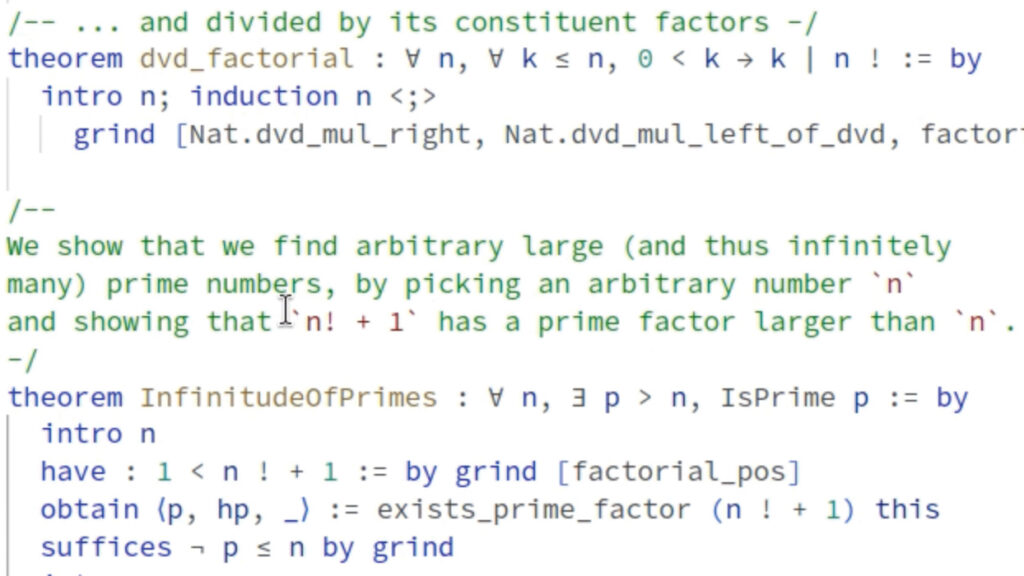 Figure 1: An example of the Lean proof assistant in action.
 Figure 2: Terry Tao, a prominent figure in the modern mathematical landscape.
Ultimately, the program seeks to ensure that the mathematics community remains the primary architect of its own future in the age of AI.