Steam Client Is Now Faster Than Epic's New Vibe Coded Launcher

Valve Outpaces Epic's "Vibe-Coded" Launcher in Rapid Speed War
By Sikandar Mahmood | October 15, 2026
Yesterday, Epic Games unveiled a preview of its latest launcher, utilizing a trendy "vibe-coded" approach to development. The core of Epic's marketing strategy was a direct shot at Steam, specifically targeting Valve's perceived sluggishness loading speeds in comparison to the new Epic iteration.
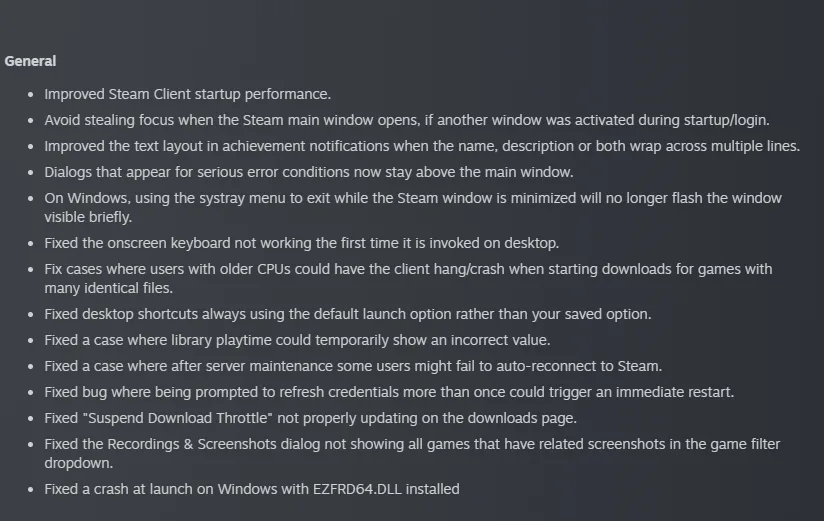
However, the victory was short-lived. In a display of rapid response, Steam deployed a minor update less than 24 hours later, effectively reclaiming the performance crown.
"not even 24h later lmao" — via X (@girlglock_)
The Performance Breakdown
The battle of the boot times reveals a tight race, but Valve ultimately edged out the competition. Based on tests conducted by u/rustenico, the numbers are as follows:
| Client Version | Startup Time (Cold Boot) | Tray Restore Speed | Architecture |
|---|---|---|---|
| Epic Games Launcher V2 (Preview) | seconds | seconds | AI-Assisted ("Vibe Coded") |
| Steam Client (Post-Patch) | seconds | seconds | Optimized Modular CEF |
To put the difference in perspective using basic subtraction: Steam is faster by approximately 0.24 seconds during a cold boot.
AI Speedruns vs. Targeted Optimization
While the Epic Games Launcher V2 represents a significant leap over its previous, notoriously slow legacy version, Valve has demonstrated its ability to pivot quickly. Epic may have used AI to "vibe code" a faster experience, but Valve proved that precise, targeted optimization of a mature ecosystem can still outperform AI-generated shortcuts.
# Simulated Boot Sequence Comparison
[SYSTEM]: Initializing Launcher...
[EPIC_V2]: Loading AI-optimized assets... [DONE] (5.47s)
[STEAM_PATCH]: Executing Modular CEF optimization... [DONE] (5.23s)
[RESULT]: Steam wins by 0.24s
More Than Just Speed: The Feature Gap
Despite the new client, Epic continues to struggle with a massive deficit in functionality. Speed is one thing, but the "vibe" doesn't replace a decade of community infrastructure.
Missing Essentials in the Epic Ecosystem:
- Community Hubs: No discussion forums or centralized hubs.
- User Feedback: Absence of written text reviews.
- Knowledge Base: No community-authored guides or walkthroughs.
- Media Sharing: No system for sharing clips, screenshots, or artwork.
- Social Networking: No curator recommendations or community groups.
- Personalization: No profile backgrounds, badges, or showcases.
- Economy: No in-game item marketplace or P2P trading.
- Gamification: No points shop, leveling system, or trading cards.
- Hardware Support: No universal gamepad support or controller remapping.
- Interface: No "Big Picture" mode for handhelds or TVs.
- Connectivity: No Remote Play or Remote Play Together.
- Streaming: No integrated broadcasting tools.
- Account Management: No family library sharing.
- Modding: No equivalent to the Steam Workshop.
- Discovery: No personalized discovery queues.
- Utility: No local network file transfers or version rollback options.
Furthermore, the "vibe-coded" approach may have come at a cost. Reports have already surfaced regarding the stability of the AI-generated store.
"The EPIC store, made entirely with artificial intelligence, seems to be a DISASTER in terms of bugs... who would have thought 💀" — via X (@eXtas1stv)

The Competitive Timeline
About the Author

Related Industry News
- Revenue Shifts: Steam PC Push Xbox First-Party Revenue Past PlayStation in 2026
- Hardware Mods: Modders are currently developing "Mihawk OS" to transform the PS5 into a Windows-based gaming machine.
 Copyright 2026 @RespawnFirst