Gdynia and the Dream of a Maritime Poland
Gdynia and the Dream of a Maritime Poland
By Juliette Bretan | October 15, 2026 Themes: #Geopolitics, #History, #War
A century ago, a quiet Baltic fishing hamlet began an extraordinary metamorphosis into a thriving maritime hub. While Gdynia served as the physical manifestation of interwar Poland's drive toward modernization, it ultimately could not shield the nation from the geopolitical storms to come.
The Wilsonian Blueprint
The foundation for this ambition lay in the penultimate goal of Woodrow Wilson’s Fourteen Points, designed to establish a lasting peace after World War I. This vision was highly idealized.
As the historian Piotr Wandycz points out, the goal was to create an independent Polish state—not simply to resurrect one—meaning it was not to be a mere carbon copy of the old Polish-Lithuanian Commonwealth that vanished in 1795.
"Wilson called for it to include ‘territories inhabited by indisputably Polish populations’... and the document called for ‘political and economic independence and territorial integrity […] guaranteed by international covenant.’"
However, there was one specific requirement that became a focal point for Polish nationalists:
- The Mandate: Poland “should be assured a free and secure access to the sea.”
The Strategic Imperative
For the Polish people, the ocean was not a luxury but a necessity. Historian Marta Grzechnik suggests that maritime access was vital to:
- Erase the perception of Poland as a
fragile, land-locked entity. - Transform the country into a "far-sighted," modern, and global power.
- Potentially establish an imperial presence on the world stage.
The Geopolitical Pincer
The path to the water was blocked by a "German-shaped obstacle." While Poland was granted a narrow corridor to the north, it was strategically suffocated.
Although Poland had rights to the port of Danzig, the city's population was overwhelmingly German, leading to constant friction. By 1920, it became clear that Poland needed its own sovereign port.
The Selection Process:
- Favorable hydrographic conditions
- Strong rail connectivity
- Available land
- Existing large-scale infrastructure (not required)
A Microcosm of a New Nation
Gdynia functioned as an "alternative capital," representing the future, while other cities represented different facets of the Polish soul.
| City | Symbolic Role | Key Characteristics |
|---|---|---|
| Warsaw | The Political Heart | Site of the Miracle on the Vistula; Art Deco skyscrapers; a mix of glitz and poverty. |
| Vilnius | The Patriotic Bastion | A center of nationalism (though contested by Lithuania). |
| Lviv | The Cultural Hub | The intellectual and artistic capital of the nation. |
| Gdynia | The Modernist Dream | A symbol of progress, industry, and maritime hope. |
The Architecture of Hope
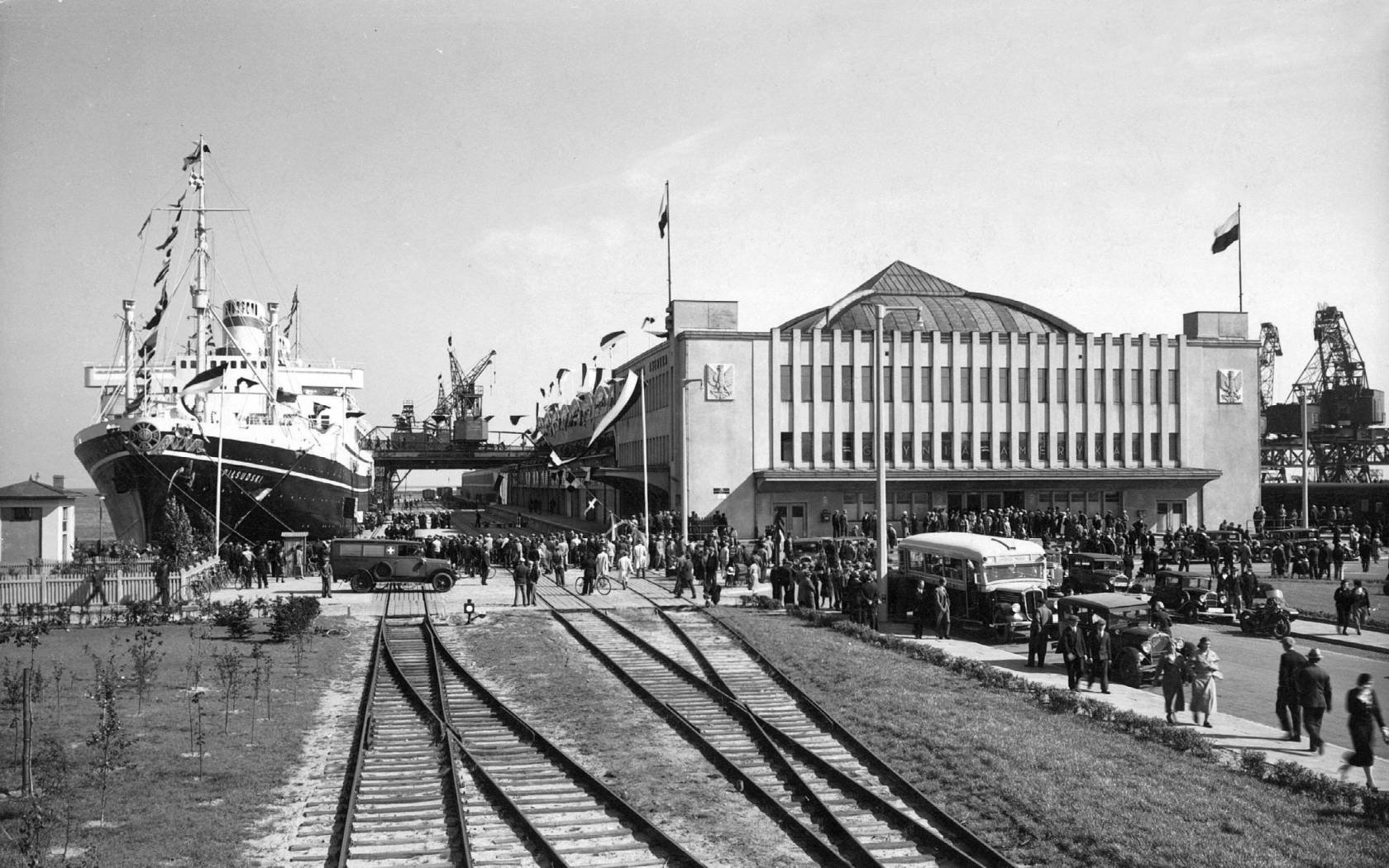
Construction began in 1921. By 1926, Gdynia was officially a city; by the late 1930s, it was a metropolis. The city's aesthetic was defined by functionalism:
- Visuals: Whitewashed walls, sweeping curves, and perpendicular lines.
- Atmosphere: Wide windows facing the Baltic, symbolizing an open gaze toward the world.
This modernity was captured in the arts. Poets praised the city's industrial machinery, and the 1935 film Rapsodia Bałtyku (Rhapsody of the Baltic) romanticized the city's naval strength and commercial success.
The Paradox of Progress
Despite the utopian facade, Gdynia revealed the fractures in the Polish dream. The port was not only for imports and exports but for departures.
PASSENGER LOG: 1933
Location: Three-storey Passenger Hall
Destination: The Americas / Atlantic
Status: Mass Emigration
Reason: Economic hardship / Political instability
While the city looked forward, thousands of citizens used the modernist terminal to flee a country where poverty remained rampant and modernity was unevenly distributed. Today, this terminal serves as the Emigration Museum.
Furthermore, Gdynia was the center for the Maritime and Colonial League, an organization that dreamed of Polish overseas colonies—a bold statement of self-confidence that often ignored the reality of their neighbors' expansionist goals.
Conclusion: An Incomplete Promise
Gdynia was the partial realization of Wilson's vision. It provided a gateway to the world and a beacon of freedom. However, it could not solve the fundamental equation of Polish security:
Ultimately, no amount of concrete or functionalist architecture could guarantee the one thing Poland needed most: a future safe from the ambitions of its neighbors.