Amazon uses AI to monitor union risk in UK warehouses
Amazon Employs AI to Track Unionization Threats in UK Facilities

For Garfield Hylton, the feeling of being watched is a daily reality. At 62, he is well aware that Amazon logs every single movement of his shift: every item scanned, the gaps between those scans, and any moment his equipment goes idle. This data is routinely used to establish productivity benchmarks.
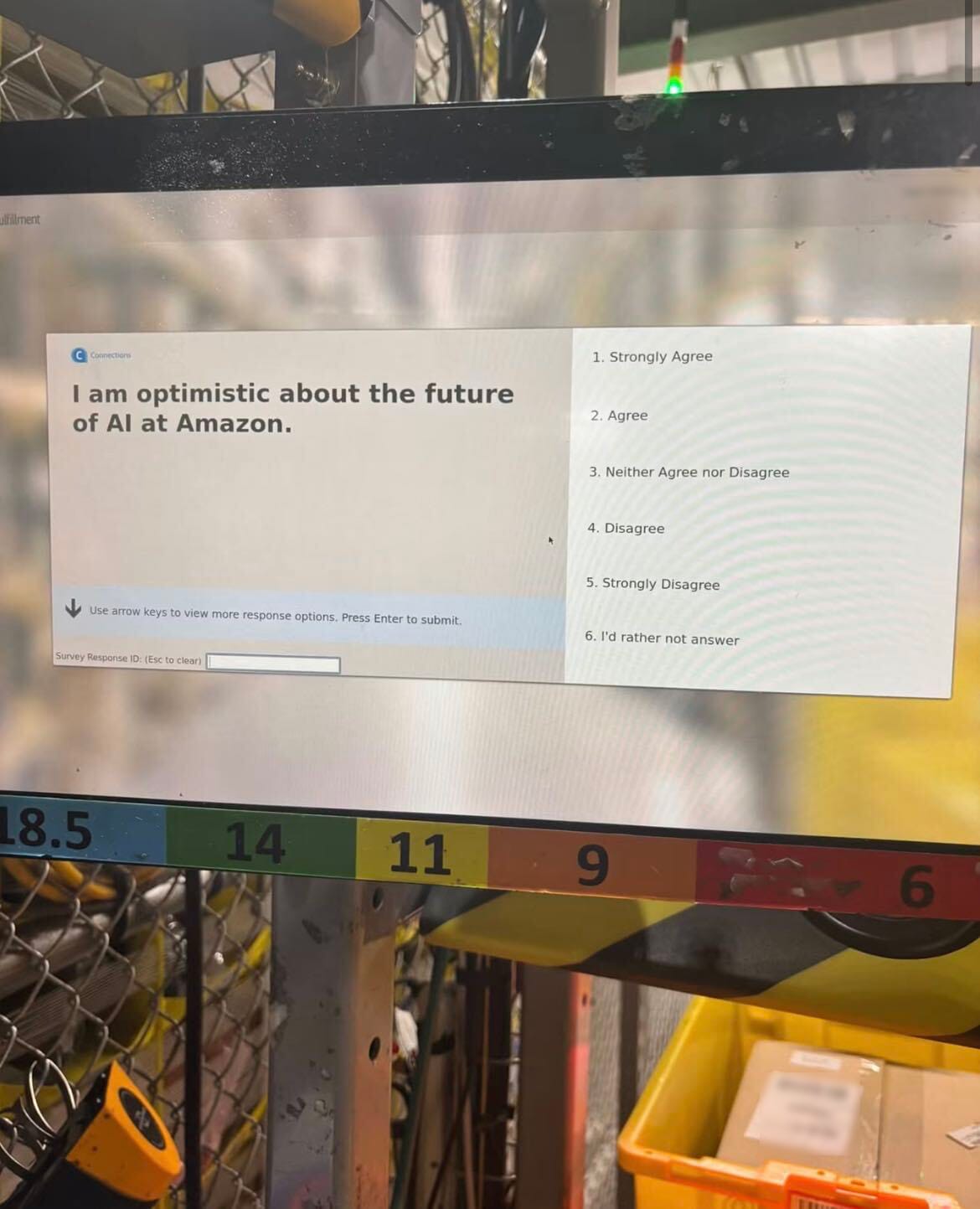
However, Hylton recently discovered a more sinister layer of surveillance. In the Coventry warehouse where he is employed, Amazon appears to be monitoring "dissent" by using artificial intelligence to scan internal bulletin boards and social media activity.
The "Atlas" Forecasting System
Internal documentation, surfaced during a legal dispute with a Canadian union, reveals the existence of Atlas. This proprietary AI tool is designed to forecast the probability of warehouse employees in the UK, US, and Canada organizing unions, initiating sit-ins, or engaging in other "disruptive labour events."
How Atlas Operates
The system aggregates a massive array of information to generate a risk profile for each location.
Data inputs include:
- Posts from Reddit forums.
- Employee feedback from internal company surveys.
- General workplace environment data.
- History of previous industrial actions.
The AI processes these "hundreds of data points" to assign a risk score. Mathematically, the risk can be represented as a value where:
In this system, lower scores indicate a higher risk of unionization or productivity-threatening activity. Conversely, Amazon leadership views higher scores as "better."
Risk Categorization and Management
Amazon classifies its warehouses into five distinct tiers based on the Atlas score. This classification is used to guide staffing choices and "mitigate risks" to the company's existing labor framework.
| Tier Level | Risk Perception | Management Action |
|---|---|---|
| Tier 1 | Future activity is imminent | High priority mitigation |
| Tier 2 | Elevated risk | Increased monitoring |
| Tier 3 | Moderate risk | Standard oversight |
| Tier 4 | Low risk | Routine maintenance |
| Tier 5 | No immediate perceived risk | Baseline operations |
According to the leaked documents, 16 warehouses are currently flagged as Tier 1. In the UK, this includes:
EMA4: The £500m robotic center in Sutton Coldfield.BHX4: The Coventry facility where Hylton works.
Conflicting Narratives
The revelation of Atlas has sparked a sharp divide between the company's public image and its internal operations.
"This makes it clear that they think the union is bad," stated Michael Newman, a partner at the law firm Leigh Day. He noted that these documents contradict Amazon's claims that they
do not seek to preventworkers from unionizing.
Amazon has pushed back against these claims, asserting that Atlas is not a tool for individual surveillance. A company spokesperson claimed:
- The tool monitors site-level activity, not individuals.
- Personal data, affiliations, or union memberships are not tracked.
- The goal is to identify where "associates" need more support.
The Human Cost and the Fight for Recognition
Garfield Hylton, a member of the GMB union, argues that this data collection creates a profound power imbalance.
"It’s not right in a democracy… the employer should not be interfering," Hylton told openDemocracy. "If you're then monitoring, you're undermining a process deliberately and willfully."
Rachel Fagan of GMB echoed this, suggesting that Amazon uses its vast wealth and technology to "outwit" workers. The struggle for recognition in Coventry has been particularly intense:
- January 2023: First-ever UK Amazon strikes.
- July 2024: A recognition ballot was lost by a razor-thin margin of only 28 votes.
The GMB and the non-profit Foxglove allege that Amazon employed "dirty tricks" to influence the outcome:
- Mass hiring of new, non-unionized staff to dilute the vote.
- Deployment of QR codes encouraging workers to cancel GMB memberships.
Summary of the Conflict
def union_battle(company_resources, worker_resources):
    if company_resources > worker_resources:
        return "Uneven playing field: AI surveillance vs. lived experience"
    else:
        return "Fair competition"

print(union_battle("High (Atlas AI, Wealth)", "Low (Experience, Solidarity)"))
 Image Credit: openDemocracy / Creative Commons Attribution-NonCommercial 4.0