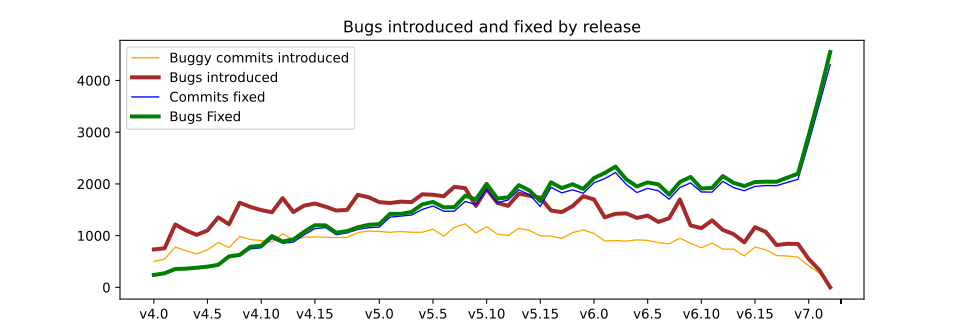
Linux bugs fixed per release over time: >2× rise since 2026-04
Analysis of Linux Kernel 7.2 Development Metrics: A Surge in Activity

On August 17, 2026, Linus Torvalds officially launched the 7.2 kernel. Despite the release, Torvalds expressed some reservations regarding the volume of incoming fixes, stating they were:
"bigger than I would have wished for"
The development cycle for 7.2 stands as one of the most intense in the project's history, characterized by the addition of nearly 600,000 lines of code.
📈 High-Level Development Statistics
The scale of this release is staggering. To understand the growth, we can look at the commit volume. There were 16,418 non-merge commits integrated into the mainline.
This was the busiest release ever Actually, it is the second-busiest in history. While the 6.7 release saw more commits, that spike was primarily due to the massive integration of the bcachefs history. In contrast, the activity in 7.2 is far more distributed across various subsystems.
Contribution Growth
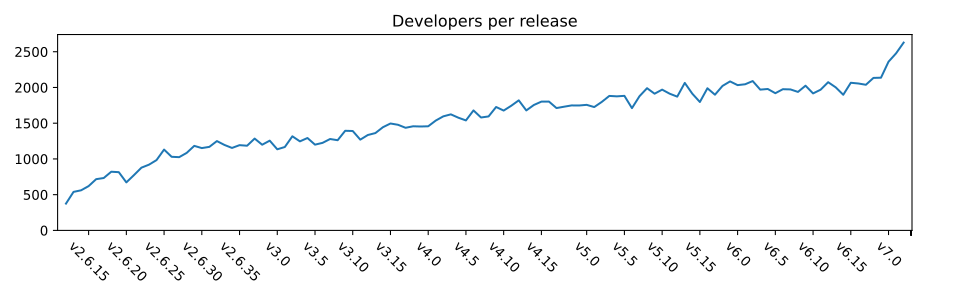
The community continues to expand. A total of 2,652 developers contributed to this release, shattering the previous record of 2,479 set by version 7.1.
The general trend since the adoption of Git can be summarized by the following growth ratio:
🏆 Top Contributors
The effort was split between those providing the most individual changesets and those contributing the largest volumes of code.
Most Active by Changesets
| Developer | Changesets | % of Total |
|---|---|---|
| Uwe Kleine-König | 151 | 0.9% |
| Rosen Penev | 146 | 0.9% |
| Ian Rogers | 138 | 0.8% |
| Johan Hovold | 133 | 0.8% |
| Arnaldo Carvalho de Melo | 131 | 0.8% |
Most Active by Lines Changed
| Developer | Lines Added/Modified | % of Total |
|---|---|---|
| Matthew Stewart | 83,587 | 8.4% |
| Hawking Zhang | 62,893 | 6.3% |
| Miguel Ojeda | 38,979 | 3.9% |
| Ian Rogers | 31,949 | 3.2% |
| Darren Ye | 20,843 | 2.1% |
Key Technical Highlights
- Uwe Kleine-König: Focused heavily on cleaning up the driver subsystem.
- Rosen Penev: Notable for submitting a large volume of LLM-authored bug fixes across crypto, networking, drivers, and architecture.
- Ian Rogers & Arnaldo Carvalho de Melo: Concentrated their efforts on the
perftool for user-space. - Johan Hovold: Improved the USB and SPI subsystems.
- Matthew Stewart & Hawking Zhang: Topped the line counts by adding massive, machine-generated
amdgpuheader files. - Miguel Ojeda: Integrated the
zerocopyRust crate into the kernel.
Example of the type of machine-generated headers added:
/* Auto-generated header for amdgpu */
#define AMDGPU_REG_X 0x12345678
#define AMDGPU_REG_Y 0x87654321
// ... thousands of similar lines ...
🔍 Quality Assurance and Review
The community relies on specific tags to ensure stability. In 7.2, the distribution was as follows:
-
Reviewed-bytags: 48% -
Tested-bytags: ~8%
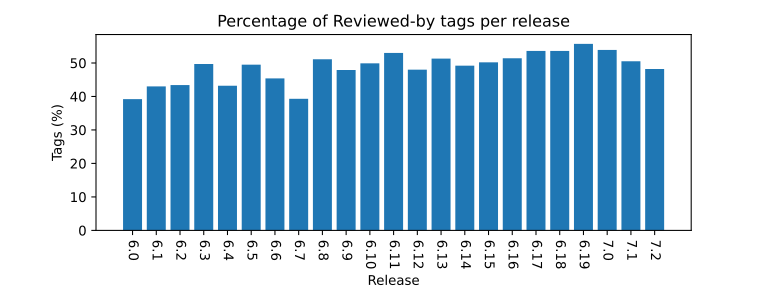
There is a slight downward trend in the use of review tags. It remains uncertain if this indicates a drop in actual review activity or simply a change in how tags are applied.
Top QA Credits
| Role | Lead Contributor | Count |
|---|---|---|
Tested-by | Dan Wheeler | 117 |
Reviewed-by | Konrad Dybcio | 231 |
Reviewed-by | Dmitry Baryshkov | 225 |
Note: Dybcio and Baryshkov continue to lead reviews for Qualcomm-related devicetree and driver files.
🏢 Corporate and Independent Support
A total of 249 employers were identified as supporting the 7.2 cycle.
Employer Impact
| Employer | By Changesets (%) | By Lines Changed (%) |
|---|---|---|
| (Unknown) | 16.7% | 10.4% |
| Intel | 9.2% | 5.4% |
| 7.3% | 10.3% | |
| Red Hat | 5.3% | 5.2% |
| AMD | 5.0% | 22.4% |
| Qualcomm | 4.7% | 5.9% |
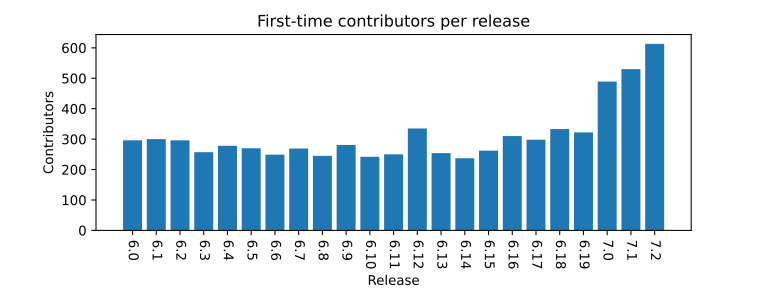
The most striking observation in the corporate data is the significant rise in developers with unknown affiliations. This shift suggests a changing landscape in how the kernel is being developed and funded.
