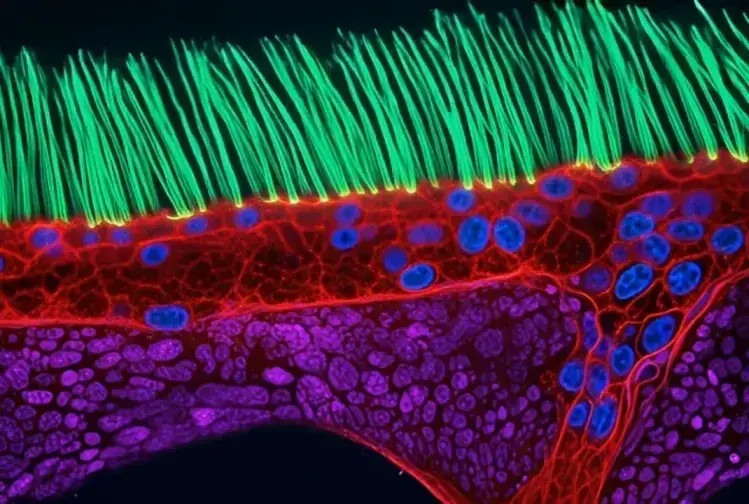
Nikon photography contest winner loses title after scientists spot signs of AI
AI Deception in Science: Nikon Strips Title from Photography Contest Winner
The "Hot Potato" Effect: The persistent trend of submitting AI-generated content into competitions designed exclusively for human creativity continues to cause friction in the artistic and scientific communities.
The prestige of one of the world's most respected scientific imaging awards was recently tarnished when a winner was forced to relinquish his title. The culprit? The discovery that the winning entry was synthesized using artificial intelligence.
The Competition: Small World in Motion
Nikon's 16th annual Small World in Motion contest invites participants to submit digital time-lapse photography or movies captured via microscopy.
The Original Winner: Ning Xu, representing Tsinghua University in China.
The Subject: A video depicting the beating of tiny cilia within the respiratory tract of a child suffering from primary ciliary dyskinesia (a rare respiratory condition).
The Investigation Process
The victory was short-lived as the scientific community began scrutinizing the footage. The process of discovery followed this general flow:
The "Telltale Signs" of AI
Several experts pointed out that the video defied the laws of cellular biology. The red flags included:
- Structural Inconsistencies: Abnormalities in the size and shape of the cells.
- Biological Impossibilities: Features that appeared and vanished spontaneously.
- The "Pop-in" Effect: An associate professor from the University of Florida noted that cilia seemed to
appear from nowhereand structures wouldpop in and out of existence. - The Smoking Gun: Ian Donovan, a PhD student at UT Southwestern Medical Center, identified a specific AI-generated watermark embedded in the source image.
Evidence Checklist
- Morphological abnormalities
- Non-biological movement patterns
- Presence of AI metadata/watermarks
- Provision of RAW grayscale footage (Never provided)
The Defense and the Verdict
In a LinkedIn post (which has since been deleted), Xu attempted to justify the AI usage. He claimed the technology was only employed during the post-processing phase to:
"distinguish and visualize features in the reconstructed grayscale images from the super-resolution optical imaging"
He insisted that the AI did not create the cilia or the movement itself. However, scientists argued that while visibility enhancement is standard, it is typically achieved through physical means, such as:
- Applying chemical stains.
- Using specific dyes on the samples.
Because Xu failed to provide the RAW grayscale video, his explanation remained insufficient. Nikon concluded that the rules had been violated and revoked the prize.
The New Champion
The top honor has been reassigned to a new winner:
| Detail | New Winner |
|---|---|
| Name | Nguyen Nam Nhat |
| Country | Vietnam |
| Subject | A single-celled organism and a tiny roundworm |
A Pattern of AI Contests
This incident is not an isolated case. The struggle to define "art" and "photography" in the age of generative AI is ongoing.
| Year | Competition | Outcome |
|---|---|---|
| 2022 | Colorado State Fair | Midjourney image won a category. |
| 2023 | digiDirect (Australia) | AI creation won a photography contest. |
| 2023 | Sony World Photography Awards | Winner refused the prize after admitting AI use. |
| 2024 | Digital Art Competition | AI winner complained he couldn't copyright his "work." |
The irony of the 2024 case is particularly sharp: the artist, who was unapologetic about using AI to win, later lamented that others were "stealing" his work, yet he lacked the legal standing to claim copyright.
Looking Forward
Nikon has stated that they will their evaluation procedures and rules to prevent future occurrences. In mathematical terms, the "Trust Factor" () of an entry can now be viewed as: